
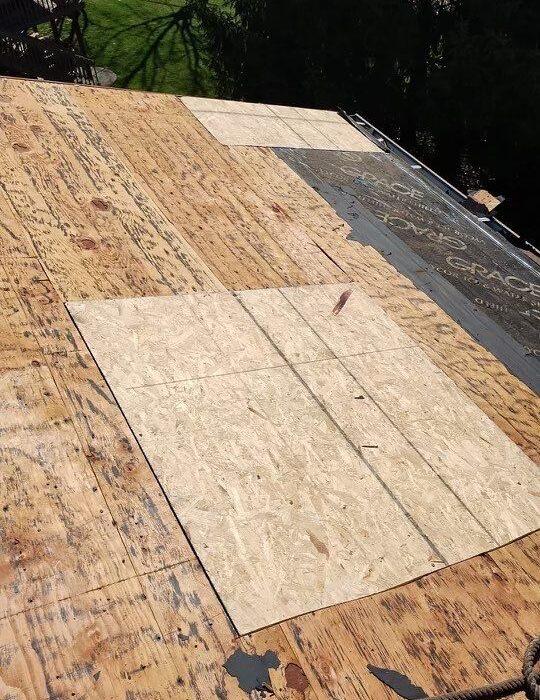
A roof redeck means tearing off your shingles and replacing the wood sheathing underneath, usually with new plywood or OSB, before the new roof goes on. You need one when the old decking is rotted, delaminated, or built from spaced boards that can’t hold a nail anymore, and in Western PA we find that condition on roughly one out of every four tear offs. Expect roof decking replacement cost to run about $70 to $125 per sheet installed, and a full redeck on an average home to add $2,500 to $7,000 to the project.
That’s the short answer. Here’s the longer one, from a crew that’s been pulling old roofs off houses around Irwin, North Huntingdon, and Greensburg since 1995.
First, What Is Roof Decking?
Your shingles don’t attach to your rafters. They attach to a layer of wood that sits on top of the rafters, called the deck or sheathing. On homes built in the last 40 years or so, that’s usually sheets of plywood or OSB. On the older housing stock we work on every week, including plenty of 1950s ranches along Route 30 and farmhouses that predate them, the deck is often individual planks nailed side by side, sometimes with gaps between them.
The deck is the foundation of the whole roof system. Every nail that holds your shingles down is only as strong as the wood it’s driven into. Soft wood means loose shingles, and loose shingles mean blow offs and leaks.
So What Is a Redeck, Exactly?
If someone asks us what is a redeck, we tell them it’s a reset of that foundation. During a redeck, we strip the roof to bare wood, remove the old sheathing entirely, and fasten new plywood roof deck panels or OSB across the rafters. Then the underlayment, ice and water barrier, flashing, and shingles all go on top of fresh, flat, solid wood.
Sometimes we only need to swap a handful of bad sheets. Other times the whole roof needs to come off down to the framing. Both count as decking replacement, but the scope changes the price a lot, which is why an honest inspection matters before you sign anything.
When Is a Redeck Actually Necessary?
Not every roof replacement needs one. Here are the situations where it’s not optional.
Rot and Water Damage
Water wins every fight with wood eventually. A slow leak around a chimney, years of poor attic ventilation, or ice dams from our freeze and thaw cycles will leave decking soft, spongy, or crumbling. If we can push a screwdriver into the wood, it can’t hold a roofing nail. Warning signs you can spot from the ground or the attic include a sagging roofline, dark stains on the underside of the roof in the attic, a musty smell up there, and shingles that keep coming loose no matter how many times they get renailed. Our post on signs you need a new roof covers the full checklist.
Plank Decking With Wide Gaps
Lots of older Westmoreland and Allegheny County homes were sheathed with boards spaced an inch or more apart, which was fine under cedar shakes or slate. Modern asphalt shingles need continuous support. When nails land in a gap instead of wood, shingles fail early and warranties get denied. On these roofs we either overlay new sheathing or do a full redeck to meet current code.
Delaminated or Fire Damaged Sheets
Plywood that’s been wet repeatedly separates into layers, and you can sometimes see the edges peeling apart at the eaves. Delaminated sheets flex underfoot and telegraph waves through the new shingles. They get replaced, period.
Multiple Old Layers Coming Off
Homes that had a second layer of shingles nailed over the first often hide decking problems for decades. When we finally strip both layers, we frequently find wood that’s been cooking under trapped heat and moisture the whole time.
How We Price It
Here’s how we handle it at Bella Construction, and how any reputable roofer should. Your estimate includes a set allowance, and we photograph every sheet we replace so you can see exactly what we found and why. Plan on roughly $70 to $125 per sheet installed. A few bad sheets might add $300 to $600 to the job. A complete redeck on a typical ranch runs a few thousand dollars on top of the base price. For the full picture of where a roofing budget goes, our breakdown of roof replacement cost in Pittsburgh walks through it line by line.
One thing we won’t do is quote a suspiciously low number and then hit you with surprise decking charges halfway through the job. Ask any contractor how they price decking before you hire them. The answer tells you a lot.
Why You Shouldn’t Skip It
Covering bad wood with good shingles is like painting over rust. The new roof might look great for a year or two, but the nails will back out, the shingles will lift in the first big windstorm, and the manufacturer will deny the warranty claim because the substrate was inadequate. We’re an Owens Corning Platinum Preferred contractor, and those enhanced warranties only hold up when the whole system, decking included, meets spec. Done right, a full roof replacement on solid decking should protect your home for decades without drama.
What the Process Looks Like
A redeck adds about a day to a typical roof replacement. We tear off the shingles and underlayment, inspect every inch of the deck, pull the sheets that fail, and fasten new panels to the rafters with proper nailing patterns. Then the roof gets built back up the right way: ice and water shield at the eaves and valleys, synthetic underlayment, new flashing, drip edge, shingles, and ridge venting so the attic can breathe and the new wood stays dry.
Frequently Asked Questions
How much does it cost to redeck a roof?
Figure $70 to $125 per sheet of plywood or OSB installed. Replacing a few sheets adds a few hundred dollars to a roof job, while redecking an entire average home usually lands between $2,500 and $7,000 depending on roof size and pitch.
Can you put new shingles over old decking?
Yes, if the decking is solid, flat, and able to hold nails. We reuse sound decking on most jobs. We only replace what’s rotted, delaminated, or too gapped to support modern shingles, and we show you photos of anything we swap.
How do I know if my roof decking is bad before tear off?
Look in the attic on a bright day. Water stains, daylight through the boards, sagging between rafters, or a musty smell all point to trouble. From outside, a wavy roofline is the big tell. A professional inspection can confirm it without pulling a single shingle.
Is plywood or OSB better for a roof deck?
Both meet code and both perform well when kept dry. Plywood handles repeated moisture a little better and holds nails slightly stronger, while OSB costs less and lays flatter. We’ll recommend the right one for your roof and budget.
Not Sure What’s Under Your Shingles?
We’ll take a look, no charge and no pressure. Bella Construction has been replacing roofs across Western PA since 1995, and we’d rather tell you the truth about your decking than sell you something you don’t need. Schedule your free inspection at mybellaroof.com or call us at 724 515 5163.

Bella Blog
Welcome to Bella Construction & Developement Inc., where excellence meets affordability in the realm of construction services.