
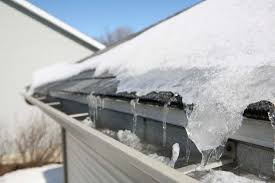
Ice in gutters forms when snow melts on a warm roof and refreezes inside the cold metal trough at the eaves, and it’s far more destructive than it looks. A fully frozen 5 inch gutter can hold 15 to 20 pounds of ice per linear foot, so a 40 foot run may be hanging 600 to 800 pounds of dead weight on hangers that were designed for flowing water. Left alone, that ice bends brackets, pulls fascia boards away from the house, and feeds the ice dams behind interior water damage repairs that commonly run $2,000 to $5,000.
We’ve been fixing that damage across Westmoreland and Allegheny counties since 1995, and every February our phones prove the same point: the homes that ice up worst are almost never random. There’s always a cause, and nearly all of them are fixable before the snow flies. Here’s what we’ve learned from thirty years of Western Pennsylvania winters.
Why Gutters Ice Up in the First Place
Our winters are practically engineered to freeze gutters. Pittsburgh area temperatures cross the freezing mark dozens of times between December and March, so we live in a constant freeze and thaw cycle. Add a lake effect snow burst on a Tuesday and a 40 degree sunny Thursday, and you’ve got meltwater pouring into gutters that refreeze solid overnight. A few conditions make it worse:
Heat escaping the attic. When your attic runs warm, the roof deck melts snow even on cold days. That water trickles down to the unheated eave edge, hits the frigid gutter, and freezes. This is the classic recipe for ice dams in gutters, and it’s especially common in the 1950s ranches all over North Huntingdon, Irwin, and Penn Township, which were built with shallow attics and insulation that wouldn’t pass muster today.
Clogged gutters. Leaves and shingle grit trap standing water. Standing water freezes first, and once a plug of ice forms, everything behind it backs up and freezes too. That’s how you end up with rain gutters full of ice from end to end.
Bad pitch. Gutters should fall about a quarter inch for every 10 feet of run. If a section has sagged flat, water pools there all winter.
Undersized or worn out gutters. Older 4 inch gutters and rusted steel systems simply can’t move winter melt fast enough.
What Frozen Gutters Actually Do to Your House
They wreck the gutters themselves. Ice expands as it freezes, popping seams and spikes loose. We replace a lot of gutters each spring that were fine in November.
They feed ice dams. Once the gutter is a solid block, meltwater has nowhere to go, so it ponds on the roof edge and creeps up under the shingles. That’s when you see stains on the ceiling below the eave. If you want to understand the wood behind all this, our explainer on what fascia and soffit are covers it, because the fascia board is usually the first thing to rot when ice pulls a gutter loose.
They dump water at your foundation. When frozen gutters finally thaw, the overflow lands right beside the house instead of running out the downspouts, which means wet basements and heaved sidewalks.
They drop ice on people. A 3 foot icicle over the front porch isn’t decoration. It’s a hazard for your kids, your mail carrier, and your car.
Six Ways to Prevent Ice in Gutters
1. Clean the gutters after the leaves finish falling. In our area that usually means mid November. A clear gutter drains fast and gives ice far less to grab onto.
2. Install gutter guards. Guards keep the debris out so water keeps moving. They’re not magic in the winter, but a covered gutter sheds meltwater dramatically better than a clogged one. We broke down the honest math in our post on whether gutter guards are worth it.
3. Fix the attic first. This is the one most homeowners skip and the one that matters most. Current guidance for our climate calls for attic insulation around R49 to R60, and plenty of local homes are sitting at half that. Pair better insulation with real soffit and ridge ventilation and your roof stays cold, the snow stays put, and the melt and refreeze cycle slows way down.
4. Add heat cables where the design demands it. North facing valleys, dead spots behind dormers, and short eaves sometimes need heat cable along the gutter and roof edge. It’s a Band Aid, but it’s the right Band Aid in a few stubborn spots.
5. Correct the pitch. If your gutters hold water in the summer, they’ll hold ice in the winter. Rehanging a sagged run is a quick fix that pays off every storm.
6. Upgrade to 6 inch seamless gutters. Bigger troughs, fewer joints, and stronger hidden hangers handle snow load and heavy melt far better than the leaky 4 inch sectional systems on many older homes. Our guide to gutter installation in the Pittsburgh area walks through sizing, and you can see the full lineup on our gutter services page.
Already Frozen? Remove Ice the Safe Way
If you’re staring at a gutter full of ice right now, resist the urge to attack it. Never chip at ice with a hammer or screwdriver, and never take a torch to it. We’ve repaired plenty of gutters, shingles, and fascia that were fine until somebody “fixed” them.
Instead, pull snow off the lower few feet of roof with a roof rake from the ground so the ice has no new water supply. Then fill a nylon stocking or sock with calcium chloride and lay it across the gutter and roof edge. It melts a channel that lets trapped water escape. Skip rock salt, which corrodes aluminum and kills the plants below. If the buildup is heavy, or you’re seeing water inside the house, call a pro. No gutter is worth a fall off an icy ladder.
When to Call Us
Reach out if your gutters are sagging or pulling away, if icicles form in the same spots every year, if you see stains on ceilings or exterior walls below the roofline, or if last winter’s ice left your gutters leaking at the seams. Those are all signs the system needs attention before the next cold snap, not after.
Frequently Asked Questions
Can I just knock the ice out of my gutters with a hammer?
Please don’t. Frozen aluminum dents and splits easily, and you’ll likely damage the shingle edge too. Use calcium chloride and a roof rake, or call a professional.
Do gutter guards cause ice dams?
No. Ice dams come from roof heat loss and refreezing at the eave, not from guards. A guard can frost over in extreme cold, but a clean, covered gutter still handles winter far better than a clogged open one.
Why do my gutters ice up when my neighbor’s don’t?
Usually attic insulation and ventilation. Two identical houses can behave completely differently if one attic leaks heat and the other doesn’t. Roof orientation and shade play a role too.
Will homeowners insurance cover ice dam damage?
Many policies cover sudden interior water damage from an ice dam, but usually not the gutter or preventable wear. Check your policy, document everything with photos, and call your agent early.
Get Ahead of Winter with a Free Inspection
Ice in gutters is a symptom. The cure is a clean, properly sized, properly pitched gutter system under a well insulated roof, and that’s exactly what we’ve been building for our neighbors since 1995. If your gutters struggled last winter, let’s look at them before the next one. Schedule your free inspection at mybellaroof.com or call us at (724) 515 5163. We’ll give you straight answers and a plan that fits your house.

Bella Blog
Welcome to Bella Construction & Developement Inc., where excellence meets affordability in the realm of construction services.