
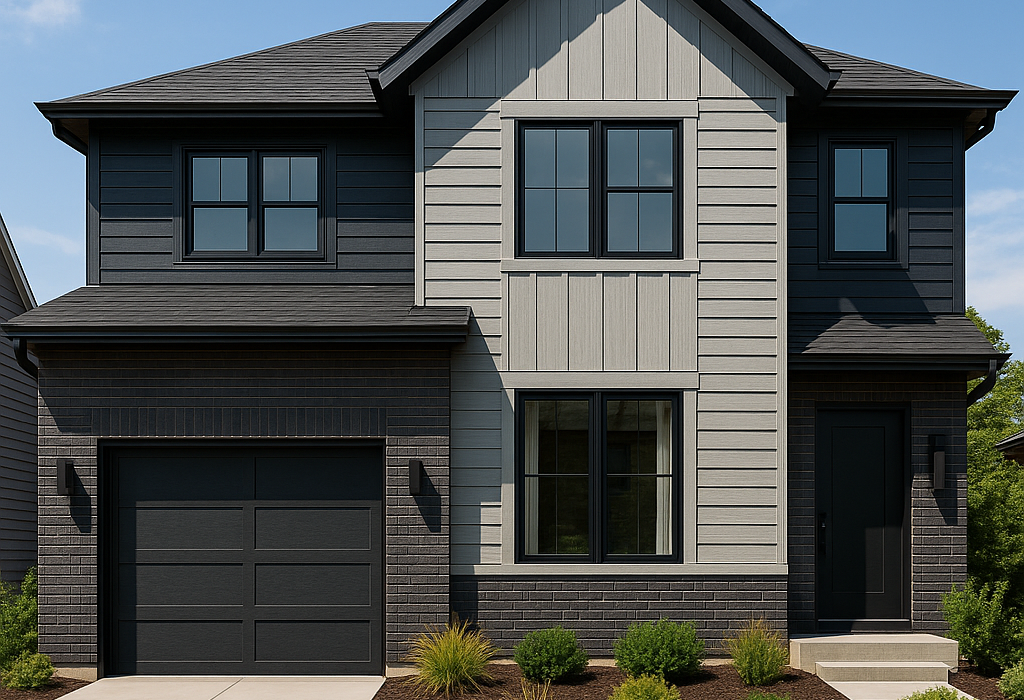
Updated July 2026. The siding colors 2026 homeowners are choosing most are deep charcoals, warm earthy greens, and creamy off whites, often mixed with vertical accents. Halfway through the year, these picks are holding strong across Westmoreland County. Here is what we are installing the most, and what each look costs, from our siding team.
The most popular siding colors for 2026 are deep greens like forest and sage, warm earthy neutrals like clay and mushroom, rich navy and charcoal, and creamy off whites replacing the stark whites of years past. The big story is warmth: the cool gray that dominated the last decade is giving way to colors with more depth and personality, usually paired with black windows or natural wood accents. If you’re residing this year, the safest bold move is a deep body color with soft white trim.
We put new siding on homes all over Irwin, North Huntingdon, Greensburg, and the Pittsburgh suburbs, so we watch these trends play out street by street, not just in design magazines. Here’s what our customers are actually choosing for 2026, and what we’d steer you toward for your own house.
The Big Shift: From Cool Gray to Warm and Deep
For about ten years, light gray was the default answer to every siding question. It’s still a fine color, but 2026 belongs to shades with more character. Homeowners are done playing it quite so safe, and manufacturers have responded with fade resistant finishes that finally make dark and saturated colors practical on siding. Advances in factory applied coatings, including reflective pigment technology in darker shades, mean you can have a moody exterior without the fading and heat problems that scared people off dark siding a generation ago.
The Siding Colors Taking Over in 2026
Deep greens. Forest green, pine, and gray leaning sage are the breakout stars of this cycle. Green sits beautifully against the wooded lots and rolling hills we have all over Westmoreland County, and it pairs with cream trim, cedar accents, and stone equally well. Sage works as a whole house color; forest green shines on a body with light trim or as a bold accent.
Warm clay and terracotta. Earthy browns, clay, caramel, and soft terracotta bring a warmth that gray never could. These tones nod to natural materials and look right at home next to the tan and red brick that’s everywhere in Western PA housing stock.
Navy and deep blue. Navy has quietly become the new neutral. It’s bold enough to stand out on the street and classic enough that it won’t date your house. Deep blue with white trim and a wood grain front door is one of the most requested combinations we install.
Charcoal and soft black. The modern favorite isn’t going anywhere. Charcoal reads sleek and architectural, hides grime well, and makes landscaping pop. Monochromatic schemes, where siding, trim, and gutters all run dark, are the boldest version of the trend for 2026.
Creamy whites and warm neutrals. White farmhouse exteriors are evolving from stark, cool whites toward cream, ivory, and greige. These softer shades feel warmer through our long gray winters and are far more forgiving about showing dust and pollen.
Misty gray, done warmer. Gray isn’t dead, it’s just warming up. Mushroom grays and taupe leaning shades give you gray’s flexibility without its chill.
Choosing a Color That Works in Western PA
A trending color still has to work on your street, under your light, next to your roof. A few local rules of thumb we share on every color consultation.
First, test against your fixed elements. Brick, stone, and your roof color aren’t changing, so your siding has to get along with them. Deep green and navy both flatter the red brick common around Pittsburgh; charcoal pairs better with tan brick and gray roofs.
Second, think about our winters. A color that looks great in a sunny catalog photo has to hold up under November cloud cover too. Warm toned colors carry gray weather better than cool ones, which is part of why the whole market is moving that direction.
Third, look at samples outside, in morning and evening light, on the actual wall. Colors shift dramatically between a showroom and a north facing wall in Irwin. We bring full size boards to every consultation for exactly this reason.
And fourth, consider resale even if you’re not moving soon. Deep greens, navy, charcoal, and warm whites all photograph beautifully and appeal to buyers. Ultra trendy accent choices are best kept to a front door, which is cheap to repaint, rather than 2,000 square feet of siding.
Color Is Only Half the Decision
The material under the color determines how long the color stays worth looking at. Field painted wood needs recoating every 5 to 7 years. Budget vinyl in dark shades can fade unevenly and distort in heat. Fiber cement with a factory cured finish, like James Hardie’s ColorPlus line, holds deep colors dramatically longer and carries a 15 year finish warranty, which is why so many of the dark, saturated 2026 colors are being ordered in Hardie. As a James Hardie Master installer, we can get you the full Statement and Dream Collection palettes, and our guide to James Hardie siding cost covers what that investment looks like in our area.
Whatever material you’re leaning toward, make sure it’s up to our freeze and thaw winters and humid summers before you fall in love with a swatch. Our comparison of the best siding for Pittsburgh weather walks through how vinyl, fiber cement, and engineered wood each hold up here.
Color choice even touches your energy bills. Lighter shades reflect summer sun and keep walls cooler, while darker shades absorb a bit of welcome passive heat in winter. Modern reflective pigments have narrowed that gap, but it’s worth a thought if your home bakes on a western exposure.
Frequently Asked Questions
What is the most popular siding color for 2026?
Deep green is the headline color of 2026, with sage and forest tones leading. Navy, charcoal, warm clay neutrals, and creamy whites round out the top tier. The common thread is warmth and depth replacing the flat cool grays of the last decade.
Are dark siding colors a bad idea?
Not anymore, as long as the material is right. Factory finished fiber cement and premium vinyl with reflective pigments resist the fading and heat distortion that used to plague dark siding. We’d be cautious about bargain grade dark vinyl on a wall with strong sun exposure.
What siding colors help resale value?
Broadly appealing depth: navy, charcoal, sage green, greige, and warm white all show extremely well in listing photos. The goal is a house that stands out on the street without making buyers wonder what repainting would cost.
Should siding be lighter or darker than the roof?
There’s no hard rule, but contrast usually wins. A dark roof over lighter siding is the classic arrangement, while dark siding under a lighter or gray roof gives you the modern look. What matters most is testing the actual pairing at your house before committing.
See 2026’s Colors on Your Own Walls
Trend lists are a starting point; your brick, your roof, and your street finish the decision. We’re a family company that’s been siding Western PA homes since 1995, and we’ll bring full size samples of every color you’re considering right to your driveway. Schedule your free inspection and color consultation at mybellaroof.com and let’s find the color your home was meant to wear.

Bella Blog
Welcome to Bella Construction & Developement Inc., where excellence meets affordability in the realm of construction services.